Key Takeaway: Partnering with a manufacturer that offers heat staking in-house ensures repeatable assemblies, reduced waste, and smoother production cycles.
For OEMs producing high-performance plastic components, assembly methods matter just as much as material selection or mold design. Heat staking is a precision joining technique used to permanently secure metal inserts or components into plastic parts, plastic to plastic connections, electronic components, circuit assemblies, and more. This creates strong, reliable assemblies without adhesives or secondary fasteners. When executed correctly, it improves durability, accuracy, and long-term product performance.
However, the value of heat staking depends heavily on how and where it’s performed. OEMs that partner with manufacturers offering in-house heat staking equipment gain greater control over quality, consistency, and cost — especially when working with engineered thermoplastics and complex assemblies.
Let’s explore how heat staking works, why equipment and process control matter, and what OEMs should look for in a manufacturing partner.
Understanding the Heat Staking Process
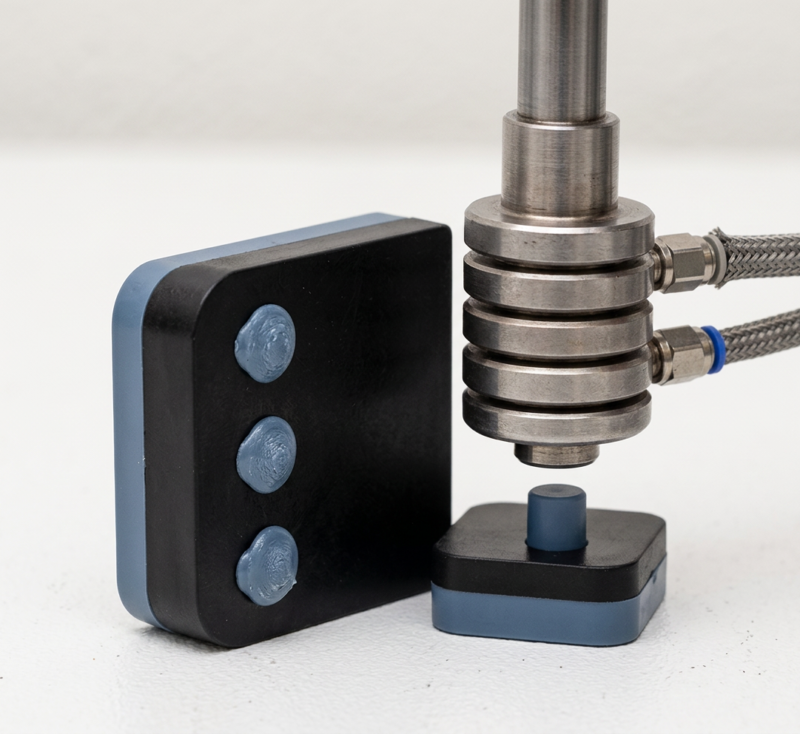
Heat staking uses controlled heat and pressure to soften plastic material around a metal insert, plastic component, electronics assembly, or another compatible part. As the plastic deforms and reflows, it captures the insert in place, forming a permanent mechanical bond once cooled. The process is highly repeatable when temperatures, dwell time, and pressure are carefully controlled.
Compared to adhesives or mechanical fasteners, heat staking offers a cleaner and more reliable solution. There are no curing times, chemical compatibility concerns, or loosening fasteners over the product’s lifecycle. The resulting joint maintains structural integrity while supporting tight tolerances and consistent performance.
Heat staking is commonly used in applications such as electronics housings, industrial equipment, automotive components, and medical device enclosures — anywhere a durable, permanent connection between plastic and metal is required.
Why Heat Staking Equipment Matters for OEMs
Not all heat staking processes deliver the same results. When staking is outsourced or performed with inconsistent tooling, OEMs often experience variability in joint strength, cosmetic defects, or dimensional issues. In contrast, manufacturers with dedicated heat staking equipment can tightly control temperature profiles, pressure application, and cycle timing.
That level of control directly impacts product reliability and lifecycle cost. Consistent staking reduces scrap, minimizes rework, and helps ensure every assembly meets specification. It also shortens lead times by eliminating handoffs between suppliers, allowing OEMs to move more quickly from molding to finished assembly.
For procurement teams, this translates to fewer quality escapes, more predictable production schedules, and greater confidence in long-term supply stability.
Integrating Heat Staking with Injection Molding and Assembly
The greatest efficiency gains occur when heat staking is integrated directly into the manufacturing workflow. When molding, heat staking, and assembly are performed under one roof, parts move seamlessly between processes without unnecessary handling or transport.
This integration reduces the risk of damage, misalignment, or contamination between steps. It also allows manufacturers to identify and address issues earlier, before they affect downstream operations.
At Ferriot, heat staking is supported by skilled technicians, controlled environments, and close coordination with injection molding and ultrasonic insertion services. The result is a streamlined process that improves throughput while maintaining tight quality standards.
What to Look for in a Manufacturing Partner
When evaluating a partner’s heat staking capabilities, OEMs should look beyond the process itself and assess how it fits into the broader manufacturing system. A capable partner will demonstrate:
- Modern heat staking equipment designed for repeatability and process control
- Trained operators and documented procedures
- Inspection and quality verification systems
- Willingness to collaborate early in the design phase
Early collaboration is especially important. Staking features must be designed into the molded part from the outset to ensure proper material flow, dimensional stability, and long-term joint performance. Ferriot’s experience with engineered plastics and complex assemblies helps OEMs balance strength, precision, and manufacturability from day one.
Partnering with Ferriot for Precision and Efficiency
Choosing a manufacturer with in-house heat staking equipment is a strategic decision that affects quality, cost, and delivery performance. OEMs benefit from tighter process control, reduced waste, and faster production timelines — all critical factors in competitive markets.
Ferriot combines heat staking with comprehensive injection molding, assembly, and program management capabilities. This integrated approach allows OEMs to consolidate suppliers, reduce risk, and maintain consistent quality across high-volume or long-running programs.