Key Takeaway: Designing injection-molded plastic parts is a tradeoff between strength, manufacturability, and efficiency. This guide shows how OEMs can improve part performance, simplify assembly, and reduce cycle time through smarter design decisions and early collaboration with the right manufacturing partner.
The design of your injection-molded plastic parts affects their structural performance, assembly complexity, and production efficiency. Therefore, it’s important to get the design right the first time. If not done correctly, you could see issues with cycle times, tooling complexity, and cost at scale. Below, we’re covering how design affects your part’s characteristics and where tradeoffs occur. Additionally, we’re highlighting how Ferriot supports design decisions that scale to production. Let’s dive in.
Why Part Design Drives More Than Just Part Performance
As mentioned above, your part design impacts a range of variables. Design decisions influence things like material flow and cooling behavior, tooling complexity and longevity, assembly methods, and labor requirements. At the same time, certain choices can improve strength, increase cycle time, and complicate molding or ejection. The key is to design injection-molded plastic parts with a balanced perspective. Avoid maximizing a single variable and you’ll achieve greater results.
At Ferriot, we provide DFM feedback early in development to align design with real production constraints. Contact us today to learn more.
Designing for Strength Without Overbuilding the Part
Ribbing vs. Wall Thickness
Increasing the wall thickness can create sinking and warpage. Not to mention, the part will take longer to cool. That’s why many engineers opt for ribbing. It’s a great way to add stiffness and maintain uniform wall sections.
Material Behavior
You’ll also have to consider the material behavior. A design that performs well in one resin can fail in another. Stiffer materials like glass-filled resins may work differently than unfilled resin. Unfilled resins might be more forgiving of complex geometries and easier to produce under load, for example. A qualified injection molding partner can help you understand which materials will be best for your particular application.
Avoiding Common Structural Design Pitfalls
There are a few common mistakes that are easy to avoid when designing a part. Adding sharp corners increases stress concentration, so you’ll want to stay away from those. Additionally, uneven wall transitions increase the risk of distortion. And finally, over-constrained features usually result in cracking during assembly or disassembly. Access points for maintenance or repairs require uniform wall thickness to avoid stress and provide durability. An experienced injection molding partner can help you optimize your part geometry to avoid these issues.
Designing Injection Molded Plastic Parts for Efficient Assembly
At Ferriot, it’s common for us to increase the efficiency of a part through its design. Here are a few strategies we might employ:
Reducing Part Count Through Integrated Design
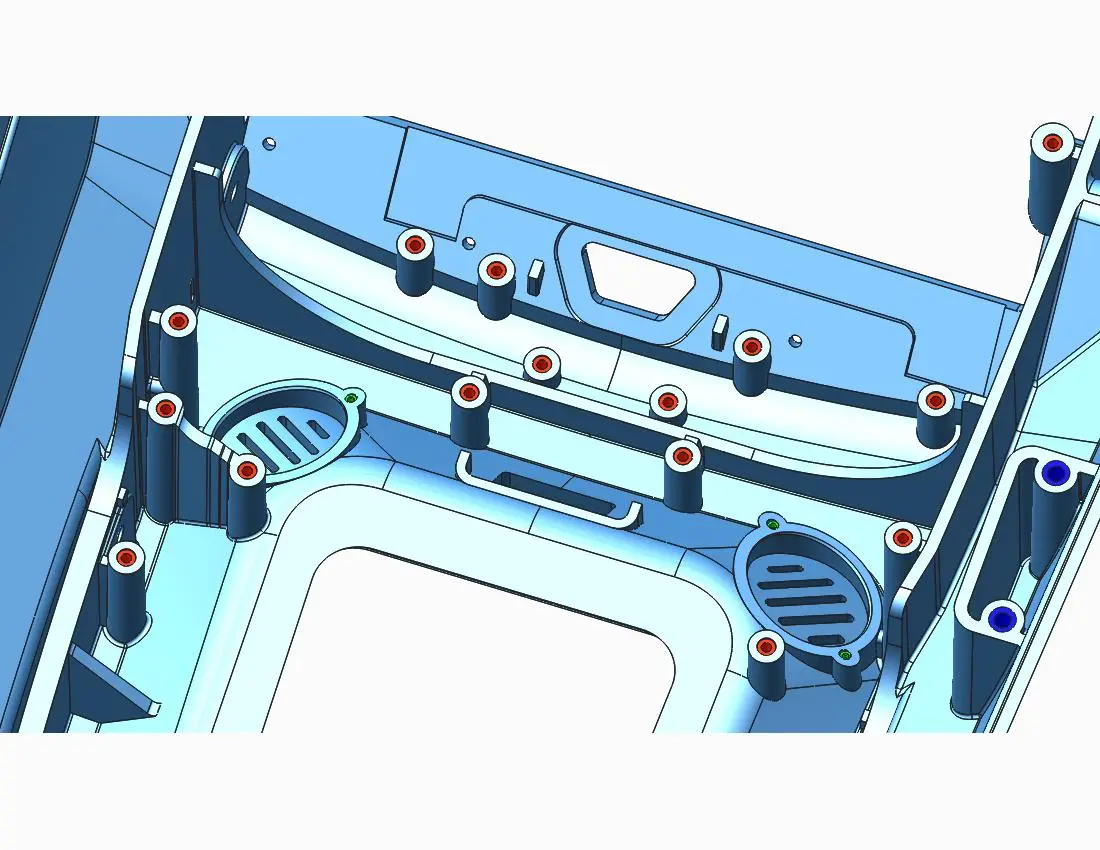
It’s common to combine features to eliminate secondary components. We might design bosses, clips, and alignment features into the part. This has a dramatic effect on your business. It lowers the amount of assembly time. It can also make the injection molding process more cost-effective, depending on the part specifics.
Fastening Strategies That Scale to Production
We can also add fastening strategies that streamline the process. We can add screws, snap fits, and inserts. These additions have a strong impact on assembly time, repeatability, and long-term durability. You’ll often see lower assembly times, which helps you get to market faster. And with higher repeatability and better long-term durability, you’ll see better end results.
Designing for Repeatable Assembly at Volume
While injection molded parts can have tight tolerances, they may vary within a range determined by your tool, material, process, and environment. Your injection molding partner should be accounting for tolerance stacking. If there are multiple characteristics of your part that are slightly off, it can result in cycle time variation, line stoppages, and field failures.
At Ferriot, our design integrates with assembly and subassembly services. We design parts with downstream operations in mind. Reach out to our team to learn more.
How Part Design Directly Impacts Cycle Time
Wall Thickness and Cooling Time
As mentioned above, thicker walls mean longer cooling times. This results in slower cycles, which can impact your bottom line. Uniform, thinner wall thicknesses expedite cycle times, allowing you to create parts more efficiently.
Geometry That Slows or Speeds Production
Deep ribs, bosses, and features can greatly impact production. They may affect fill and complicate ejection. That’s why it’s so important to design features that support consistent molding. A qualified injection molding partner can help you optimize your design to avoid common issues.
Tooling and Process Considerations
Decisions made during this stage have an impact on where the gate can be placed, how far material has to travel to fill the cavity, and how efficiently the part can be cooled. These factors all determine whether your part comes out right and how fast it can be produced. Designing with the tooling and process considerations in mind from the start allows you to maximize your efficiency.
Balancing Strength, Assembly, and Cycle Time
It doesn’t have to be difficult to get the right balance of strength, assembly, and cycle time with your parts. Many businesses understand that stronger parts often increase complexity. At the same time, simpler assembly may require more design effort up front. And faster cycles require disciplined geometry. These decisions are all made in the CAD design process. They directly impact cost per part, assembly efficiency, and production scalability.
At Ferriot, we offer a cross-functional approach that blends engineering, production, and assembly. We help OEMs avoid tradeoffs that create downstream costs.
Designing for Manufacturability from Day One
It’s extremely important to design for manufacturability from day one. Late-stage changes can be costly. Tooling modifications, production delays, and revalidation all add up. With early design for manufacturing support, you can identify risks before the tooling process begins. Additionally, it aligns expectations across teams.
At Ferriot, we offer in-house engineering support. Our design feedback is grounded in real production expertise. This allows us to focus on repeatability and long-term performance for your products.
Why Execution Experience Matters
Even well-designed parts can fail without proper execution. You have to consider the variability in the material, processing, and assembly. All of these factors can undermine design intent. That’s why it’s so important to partner with a company that has experience in executing projects like yours. OEMs benefit from partners who:
- Understand complex geometries
- Control process variables
- Support production at scale
Ferriot is the partner you need to get the results you’re looking for. We are a technical execution partner focused on consistency.
Designing Injection Molded Plastic Parts That Perform at Scale With Ferriot
If you need a partner who can design injection-molded plastic parts, turn to Ferriot. We are a U.S.-based, full-service custom injection molder and contract manufacturer centrally located in Ohio. We provide creative, value-added solutions to manufacture products for OEM clients around the globe. Privately held since 1929, we’re committed to solving your most complex challenges. You can rely on our injection mold tooling design expertise, manufacturing capabilities, and team of veteran engineers and skilled technicians.
We maintain a 200,000-square-foot office and manufacturing facility in Akron, Ohio. This facility supports full-service contract manufacturing, including:
- Engineering
- Tool Design
- Injection Molding
- Sub- and finished assembly
- Delivery of components and finished products
Organizations in a range of industries trust Ferriot for their products. We support sectors like automated banking, medical equipment, industrial machinery, automotive, and more. Are you ready to learn more about what we can do for you? Reach out to our team today.