Key Takeaway: EMI enclosure design isn’t optional for many electronic systems; it’s a risk-mitigation decision. This guide explains when shielding is required, common design mistakes, material and process tradeoffs, and how OEMs can execute EMI enclosures reliably at production scale with the right manufacturing partner.
Electronic enclosures are often treated as protective shells. In reality, for many systems, they are functional components that play a critical role in performance, compliance, and long-term reliability. Nowhere is this more evident than in EMI enclosure design.
Electromagnetic interference issues rarely announce themselves early. Instead, they tend to surface during late-stage testing, regulatory certification, or — worst case — after deployment in the field. At that point, OEMs are faced with expensive redesigns, tooling changes, delayed launches, and unexpected compliance risk.
This is why EMI enclosures must be treated as engineered systems, not add-ons. In this article, we’ll look at when EMI shielding is required, how enclosure design directly influences EMI performance, and how material and process decisions impact execution at scale. We’ll also explore how Ferriot supports OEMs by helping them design and manufacture EMI enclosures that perform reliably in real-world production — not just in theory.
What EMI Means for Electronic Systems (Without the Theory Dump)
From a practical standpoint, EMI becomes a problem when electronic systems either emit unwanted electromagnetic energy or are susceptible to interference from their environment. Both scenarios can disrupt system performance, cause intermittent failures, or prevent products from meeting regulatory requirements.
In enclosure design, two concepts matter most. Emissions refer to what a device gives off, while susceptibility refers to what it’s vulnerable to. An EMI enclosure often addresses both, acting as a physical barrier that limits interference entering or escaping the system.
For OEMs, the takeaway isn’t about mastering electromagnetic theory; it’s about recognizing that enclosure design is frequently the first and most effective line of defense. When EMI is not addressed structurally, it often resurfaces later in the form of patchwork solutions that increase cost and complexity.
When an EMI Enclosure Is Required (and When It’s Often Missed)
EMI shielding becomes necessary in a wide range of modern electronic systems, particularly as electronics become faster, denser, and more interconnected. High-speed circuitry, compact PCB layouts, power electronics, and systems operating near sensitive equipment all increase the likelihood of EMI issues.
The challenge is that these risks are not always obvious early in development. Many OEMs discover EMI problems only during compliance testing or system integration, when options are limited and expensive. At that stage, attempting to “add shielding later” often means redesigning enclosures, modifying tooling, or introducing secondary components that complicate assembly.
From a procurement perspective, early identification of EMI risk is one of the most effective ways to control cost and schedule. When EMI enclosure requirements are understood upfront, they can be designed into the part rather than forced on afterward.
How Enclosure Design Influences EMI Performance
While shielding materials and coatings often get the most attention, enclosure design itself plays a critical role in EMI performance. Geometry, seams, fastening strategies, and assembly consistency all influence how effectively an enclosure limits electromagnetic leakage. In many cases, EMI issues are not caused by insufficient shielding material, but by design decisions that unintentionally create leakage paths once the enclosure is molded, assembled, and put into service.
Seam Design and Electrical Continuity
Seams are one of the most common sources of EMI leakage in plastic enclosures. Wherever two enclosure halves meet, even small gaps or inconsistencies can compromise electrical continuity and reduce shielding effectiveness. Factors such as mating surface flatness, fastener spacing, and tolerance stack-up all influence how well seams perform in production.
Repeatable closure pressure is especially important. If pressure varies from one assembly to the next, shielding performance can vary as well, introducing risk during compliance testing or field deployment. Variability in molded parts, whether from inconsistent wall thickness, warpage, or material behavior, can further undermine seam integrity. This is why enclosure design, tooling quality, and process control must work together to ensure seams perform consistently at scale.
Openings, Ventilation, and Access Points
Openings are often unavoidable in electronic enclosures, whether for ventilation, connectors, displays, or service access. However, these features are also frequent EMI failure points if not carefully considered early in design. Large vents, unshielded cutouts, or poorly placed access panels can allow electromagnetic energy to escape or enter the enclosure, reducing overall effectiveness.
Balancing thermal management with EMI performance is a common challenge. Decisions made to improve airflow or accessibility can inadvertently create compliance issues later if shielding implications are not addressed upfront. Coordinating enclosure geometry with electronics layout and system requirements early helps avoid late-stage redesigns, when changes are more costly and disruptive to schedules.
Fastening Strategy and Assembly Impact
Fastening methods have a direct impact on EMI performance, particularly where electrical continuity across seams is required. Screw count, placement, and torque consistency all influence how effectively enclosure halves remain bonded during use. In EMI-sensitive applications, inconsistent fastening can introduce micro-gaps that compromise shielding integrity over time.
Snap fits and other tool-less fastening features can simplify assembly, but they require careful evaluation in EMI-critical designs. Assembly consistency becomes just as important as part geometry. Even a well-designed enclosure can underperform if assembly variation is introduced at volume. This is where early DFM collaboration, disciplined assembly processes, and tight production control help ensure EMI enclosures perform as intended, not just in testing, but throughout their lifecycle.
Material Selection for EMI Enclosures
Material choice plays a foundational role in EMI enclosure performance, but it’s rarely a simple decision. Ferriot commonly processes thermoplastics such as ABS, polycarbonate (PC), and PC/ABS blends for electronic enclosures, selecting materials based on the combined demands of performance, manufacturability, and downstream shielding compatibility.
Each material introduces tradeoffs. OEMs must balance impact resistance, weight, durability, and cost while ensuring the enclosure can support the chosen EMI mitigation approach. Material behavior also affects how well conductive coatings adhere and how stable the enclosure remains over time.
Consistency is equally important. For repeat production, material traceability and controlled sourcing help maintain predictable EMI performance across builds. Variability in resin behavior can translate directly into variability in shielding effectiveness, which is unacceptable for regulated or mission-critical systems.
EMI Shielding Methods Used With Plastic Enclosures
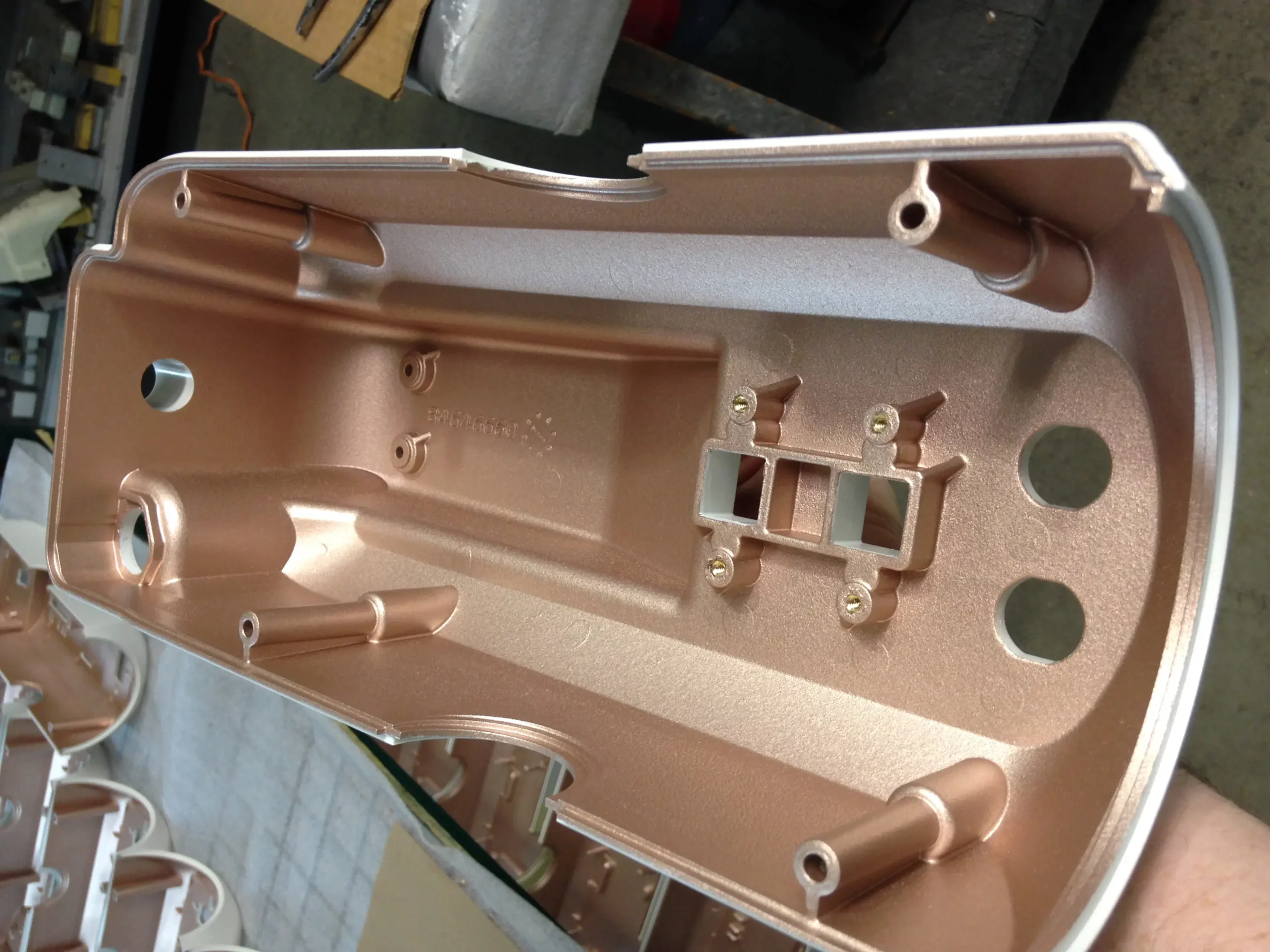
Plastic enclosures typically rely on secondary shielding methods to achieve EMI performance. Common approaches include conductive coatings applied to interior surfaces and internal shielding components integrated into the enclosure design.
Each method carries design implications. Coatings require careful surface preparation and geometry that allows uniform application. Inserts or internal shielding components must be accounted for during molding and assembly to ensure they remain effective without complicating production.
Ferriot supports EMI enclosure execution by designing parts that can reliably accept shielding processes. Coordinating molding, finishing, and assembly under one roof helps maintain shielding integrity while reducing handling and variability that can compromise performance.
Designing EMI Enclosures for Manufacturability and Assembly
Many EMI enclosure designs fail not because the concept is flawed, but because they don’t scale well to production. Overly complex features, inconsistent tolerances, and poorly planned seams can introduce variability that undermines both EMI performance and assembly efficiency.
Early DFM collaboration is essential. Ferriot’s in-house engineering team provides design feedback before tooling begins, helping OEMs simplify features, control tolerances, and align enclosure geometry with real manufacturing constraints. Disciplined process control during production further ensures that EMI-critical features perform consistently over time.
Testing, Compliance, and Lifecycle Considerations
EMI enclosure design must account for more than initial testing. Long-term product lifecycles, service access, and revision control all influence how enclosures perform over years of production.
From a procurement standpoint, predictability matters. Consistent execution reduces certification risk, minimizes surprises during scale-up, and supports smoother lifecycle transitions. Ferriot’s program management approach helps OEMs manage revisions, volume changes, and long-term support without sacrificing enclosure performance or quality.
Why Execution Experience Matters for EMI Enclosures
EMI enclosures are unforgiving of variability. Small deviations in material behavior, tolerances, or assembly can compromise shielding effectiveness.
OEMs benefit from working with partners experienced in producing large and complex housings with tight tolerances and integrated secondary operations. Domestic manufacturing and strong program management further reduce risk by improving communication, responsiveness, and control.
Ferriot approaches EMI enclosure programs as risk-reduction exercises, combining engineered thermoplastics expertise, large-part molding capability, and integrated finishing and assembly to support reliable execution at scale.
Partner With an Expert in EMI Enclosure Manufacturing
Effective EMI enclosure design starts early and extends through every phase of execution. Material choice, enclosure geometry, tooling strategy, and manufacturing discipline are inseparable — and shielding only works when the enclosure is designed to support it.
Ferriot brings the experience and infrastructure OEMs need to execute EMI enclosures with confidence. With engineered thermoplastics expertise, large-part molding capability, integrated molding and finishing, and disciplined program management, Ferriot helps reduce risk before tooling begins and ensures enclosures perform in production.