For OEMs building high-performance plastic assemblies, joining methods play a critical role in product integrity, appearance, and long-term reliability. Ultrasonic welding has emerged as one of the most efficient and precise ways to bond thermoplastic components — especially for applications where clean assembly, tight tolerances, and repeatable performance are essential.
Today’s ultrasonic welding technology is evolving quickly. From digitally controlled equipment and automated handling systems to enhanced process monitoring and traceability, recent innovations are expanding what manufacturers can achieve with this method.
In this blog, we’ll take a practical look at how ultrasonic welding works, where it’s advancing, and why OEMs across industries rely on it to improve part performance and assembly efficiency. We’ll also share how Ferriot’s in-house ultrasonic welding capabilities support high-quality injection-molded assemblies at scale.
How Ultrasonic Welding Plastic Supports Complex Part Assembly
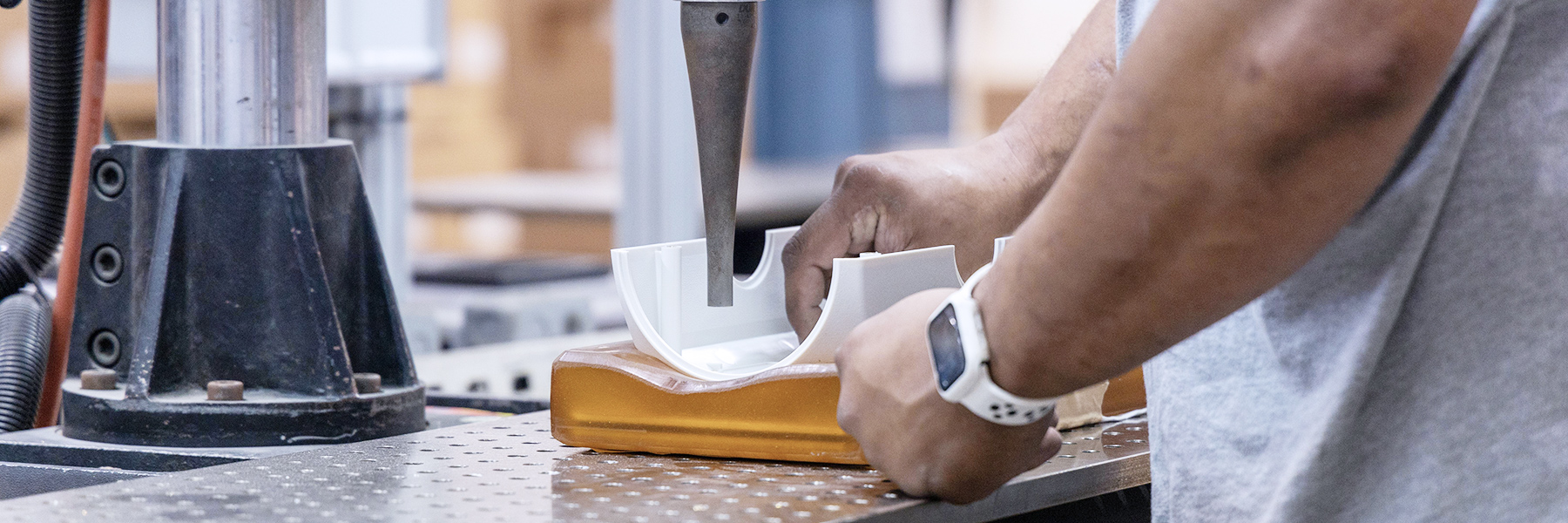
Ultrasonic welding joins thermoplastic parts by applying high-frequency mechanical vibrations to generate frictional heat at the joint interface, creating a clean, molecular-level bond. Because heat is localized, there is minimal thermal impact on surrounding material, making it ideal for precise assemblies and parts with demanding dimensional requirements.
This method is widely used for components made from materials such as ABS, PC, PP, and nylon, and supports both simple and intricate geometries. Compared to adhesives or mechanical fasteners, ultrasonic welding eliminates curing time, avoids surface contamination, and maintains the part’s structural integrity.
Industries like medical equipment, industrial electronics, and business machines rely on ultrasonic welding to create sealed housings, functional assemblies, and durable fastening points without adding hardware or chemicals.
Innovations Driving Ultrasonic Welding Plastic Forward
Advancements in ultrasonic welding are improving repeatability, control, and automation — key benefits for OEMs scaling production.
Modern systems now incorporate adaptive digital controls that monitor weld parameters in real time, automatically adjusting energy levels and timing to ensure consistent results. Intelligent feedback systems also support validation and traceability in regulated industries, such as medical and industrial electronics.
Automation is growing as well. Robotics and automated part-positioning systems reduce manual handling and enable higher throughput with fewer labor touchpoints. These updates not only improve weld quality but also enhance process efficiency across high-volume runs and complex assemblies.
Combined, these innovations make ultrasonic welding a powerful tool for OEMs focused on precision, speed, and repeatable quality.
Key Benefits for OEMs
Ultrasonic welding delivers strong, clean, and repeatable joints, without adhesives, screws, or solvents. For OEMs focused on efficiency and quality, the benefits are significant:
- Fast cycle times — welds complete in seconds for streamlined assembly
- Clean, precise joints — no residue, curing time, or secondary finishing required
- Strong molecular bonds — proven durability under vibration and mechanical stress
- No added hardware or adhesives — reduces cost, weight, and environmental impact
These advantages help manufacturers shorten assembly time, improve aesthetics, and maintain consistency across large production volumes.
Design Considerations for Effective Ultrasonic Welding
Achieving the best results starts with thoughtful part and joint design. Successful ultrasonic welding depends on factors such as joint geometry, wall thickness, and the use of energy directors to focus vibrational energy where bonding occurs.
Material compatibility also matters — thermoplastics must have similar melt characteristics to ensure a strong, uniform bond. By involving a manufacturing partner early, OEMs can validate these choices up front, preventing redesigns or tooling modifications later in the program.
Ferriot supports early-stage planning through DFM guidance, material insight, and weld-specific design recommendations that help ensure strong, repeatable welds and high first-pass yield rates.
Ferriot’s Ultrasonic Welding Plastic Capabilities
Ultrasonic welding is an integral part of Ferriot’s full-service plastic assembly capabilities. Our in-house equipment and experienced technicians support both ultrasonic welding and ultrasonic insertion, enabling clean and durable fastening solutions without adhesives or mechanical hardware.
Because Ferriot pairs welding with molding, decorating, assembly, and program management under one roof, OEMs benefit from streamlined workflows, consistent quality control, and simplified vendor management. This integrated approach reduces lead time and ensures each welded assembly meets performance and aesthetic requirements before shipment.
Unlocking Value Through Ultrasonic Welding
For OEMs prioritizing precision, durability, and assembly efficiency, ultrasonic welding continues to deliver exceptional results; innovations in equipment and automation are only increasing its value. Strong, clean welds paired with fast cycle times help OEMs bring better products to market more efficiently and reliably.
Ferriot combines advanced welding equipment, cross-functional engineering support, and end-to-end manufacturing capabilities to help OEMs get the most from ultrasonic welding — whether launching a new program or improving an existing assembly process.
Ready to strengthen your next product with ultrasonic welding? Contact Ferriot to explore how our ultrasonic welding and integrated production services can support your assembly and performance goals.