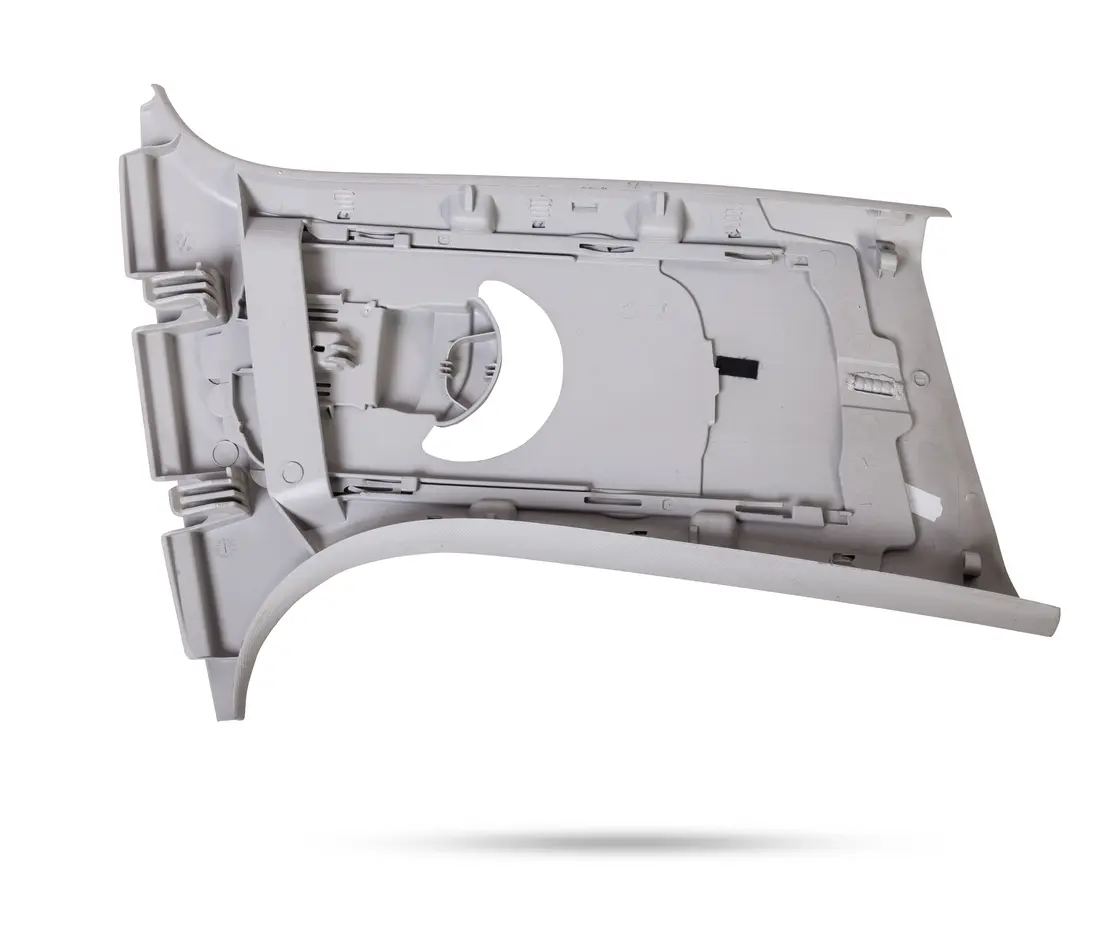
Key Takeaway: Large-scale plastic molding requires different design and manufacturing strategies than small-part molding due to increased risks of warpage, deflection, and material variation. OEMs must account for these factors early to ensure structural performance, durability, and consistent production at scale.
Large plastic parts are not simply scaled-up versions of smaller components. As size increases, so do the risks of problems like warpage, deflection, inconsistent material behavior, and long-term durability concerns.
For OEMs developing oversized plastic components used in industrial equipment, medical enclosures, or transportation systems, the challenge is not just achieving performance; it’s doing so in a way that can be manufactured consistently and economically at scale. Without the right design approach and production strategy, these programs often encounter costly issues during tooling, scaling, or field use.
Let’s explore the real-world challenges of large-scale plastic molding and how experienced execution helps solve them.
Why Large-Scale Plastic Molding Introduces Unique Challenges
As part size increases, multiple variables begin to compound during manufacturing. What may be manageable in smaller components becomes significantly more complex when scaled.
For instance, larger spans increase the likelihood of deflection, warpage, and sink, particularly when structural design and material behavior are not aligned. At the same time, longer flow lengths make it more difficult to fill parts consistently, which increases the risk of incomplete fill or variation across the part.
Cooling also becomes more complex. Uneven cooling across a large surface area can introduce internal stress, which may not be visible immediately but can affect long-term performance. Tolerance control is another challenge: small deviations across a large footprint can create fitment issues during assembly.
Even handling and ejection require more control. Because of this, larger parts demand more disciplined processing to avoid distortion during removal from the mold.
These challenges are interconnected. Addressing one often impacts another, which is why large-scale plastic molding requires a coordinated approach across design, material selection, and process control.
Common Failure Points in Large-Scale Plastic Molding Programs
Large-scale plastic molding programs rarely fail because of a single issue. More often, problems arise from early assumptions that don’t hold up under real production conditions.
Common failure points include:
- Designing for CAD, not manufacturing: Geometry that looks correct in design may not support consistent material flow, cooling, or ejection in large molds
- Underestimating scale effects: Flow length, shrink, and cooling behavior do not scale linearly; what works in smaller parts can introduce risk in larger components
- Delaying manufacturing input: Waiting until after design is finalized to involve a molder often leads to costly tooling revisions and timeline delays
- Overlooking tolerance accumulation: Small dimensional variation across large parts can create fitment issues during assembly
- Treating tooling as a one-time investment: Tool wear, maintenance, and long-term performance are often not accounted for early, leading to variability over time
- Assuming early success guarantees scalability: Parts that pass initial sampling may not hold performance across extended production runs
These issues are not always visible during early development, but they tend to surface during tooling, scale-up, or field use, when they are significantly more expensive to correct.
The good news is that most of these failure points are preventable. Aligning design, material selection, and manufacturing strategy early in the process helps reduce risk and ensures the part performs not just in theory, but in production.
Structural Design Strategies for Oversized Plastic Parts
Design is one of the most powerful levers for improving performance in large plastic components. The goal is to achieve strength and durability without introducing unnecessary material or manufacturing complexity.
Reinforcement Without Overbuilding
Increasing wall thickness alone is rarely the best solution. Thicker sections can lead to sink, longer cooling times, and increased risk of warpage.
Instead, reinforcement strategies such as ribbing allow designers to increase stiffness while maintaining more uniform wall thickness. Strategic geometry helps distribute loads more effectively, reducing stress concentrations across the part.
Designing for Real-World Loads and Use
Large parts are often subject to real-world forces such as vibration, impact, and repeated use. Designing for these conditions means accounting for how the part will actually perform over time, and not just under ideal conditions.
This includes reinforcing mounting points, supporting load-bearing features, and avoiding sharp transitions that can create stress concentrations.
Designing for Manufacturability at Scale
Even well-designed parts can fail in production if manufacturability is not considered early. Geometry must support consistent material flow and avoid features that create uneven cooling or fill challenges. Early DFM collaboration is especially important for large parts. Issues that might be minor in smaller components can become major problems after tooling begins.
Designing for Long-Term Performance and Lifecycle Reliability
Design decisions don’t just affect how a part performs at launch; they determine how it holds up over time.
Large plastic components are often exposed to fatigue, creep, and environmental conditions that can degrade performance if not accounted for early. Designing with these factors in mind helps ensure the part maintains structural integrity throughout its lifecycle.
Consistency across production runs is just as important. Variability in material behavior, processing conditions, or tooling performance can lead to differences in how parts perform in the field.
From a procurement perspective, this translates directly to fewer field failures, lower lifecycle costs, and reduced production risk. Aligning design, material selection, and manufacturing strategy early helps ensure long-term reliability.
Material Selection for Structural Performance at Scale
Material behavior becomes more critical as part size increases. Properties that perform well in smaller parts may not translate the same way across larger geometries, especially when flow length, cooling, and structural demands change.
Common materials used in large-scale plastic molding include ABS, polycarbonate (PC), PC/ABS blends, and, in some cases, glass-filled materials for added stiffness. Each comes with tradeoffs that must be evaluated in the context of the full part design and application.
Key material considerations for large parts include:
- Stiffness vs. weight: Maintaining structural integrity across large spans without adding unnecessary mass
- Impact resistance: Ensuring durability under real-world conditions, such as vibration or handling
- Thermal performance: Accounting for expansion, contraction, and environmental exposure
- Shrink behavior: Managing dimensional variation over long flow lengths
- Surface quality: Preventing defects that become more visible across larger areas
- Processability: Ensuring the material can be molded consistently without introducing variability
Material consistency is just as important as selection. Variations in resin properties can lead to warpage, cosmetic defects, or inconsistent mechanical performance. All of these issues are amplified in large-format parts. Careful alignment between material choice, part design, and processing conditions is essential to achieving repeatable, high-quality results at scale.
Evaluating materials for a large-part program? — Ferriot works with OEM teams to align material selection with structural performance and real-world manufacturing requirements.
Tooling and Processing Challenges in Large-Scale Molding
Tooling for large parts introduces its own set of challenges. Mold design must account for long flow paths, proper gate placement, and the ability to achieve uniform fill and packing across the part.
Cooling is one of the most critical aspects of the process. Achieving uniform cooling helps reduce internal stress and dimensional variation, but it must be balanced with cycle time requirements. Longer cycles can increase cost, so optimizing cooling efficiency is key.
Process control becomes even more important at scale. Temperature, pressure, and fill rates must be tightly controlled to maintain consistency across production runs. Small variations can have a larger impact when applied across a larger part.
When to Consider Structural Foam or Alternative Processes
In some cases, traditional injection molding may not be the most efficient solution for large parts.
Structural foam molding can offer advantages such as improved stiffness-to-weight ratio, reduced sink, and lower internal stress. These benefits make it a strong candidate for certain large, load-bearing applications.
However, there are tradeoffs. Surface finish may be less refined, and tooling and process requirements differ from standard injection molding. Selecting the right process depends on the application’s performance requirements and production goals.
Want to know which process is right for your part? — Talk with Ferriot to align process selection with your design, performance, and production goals.
Integrating Secondary Operations for Large Components
Large plastic components often require additional operations beyond molding. Painting, assembly, and machining are common requirements. But managing these operations across multiple suppliers can introduce risks such as miscommunication, delays, and inconsistent quality.
Look for a manufacturing partner that integrates molding and secondary operations under one roof. This helps OEMs improve quality consistency, reduce lead times, and maintain better control over the overall program. It’s an advantage that becomes increasingly valuable as part size and complexity increase.
Why Execution Experience Matters in Large-Scale Plastic Molding
Large-scale molding is less forgiving than smaller-part production. Variability in material, process, or tooling can have a greater impact on performance.
Successful programs require experience with large molds, complex geometries, and integrated manufacturing processes. Maintaining process control across long production runs is essential to delivering consistent results.
Partner with Ferriot for Successful Large-Scale Plastic Molding
Large-scale plastic molding requires more than strong design; it requires execution that supports performance, consistency, and long-term durability. Material selection, structural design, tooling strategy, and process control must all work together to produce reliable oversized components.