Key Takeaway: An outdoor EV charger enclosure should be engineered, not designed as a cosmetic covering. The installation environment, required ratings, material selection, structural design, sealing, thermal management, and manufacturing process all affect long-term performance. Defining those requirements early can reduce redesign risk and improve the path to production.
For outdoor electric vehicle (EV) charging stations, enclosure design affects more than appearance. The EV charger enclosure protects internal electronics, and its design directly affects durability, installation, serviceability, long-term field performance, brand appearance, and manufacturing costs.
For plastic EV charger enclosure programs, the key decisions set the foundation for the part’s performance. The enclosure needs the right material for the environment, the right structure for field loads, and the right manufacturing process for repeatable production. Making those decisions before the tooling is cut is more cost-effective than doing so after issues arise in the field.
The EV Charger Enclosure is the First Line of Protection
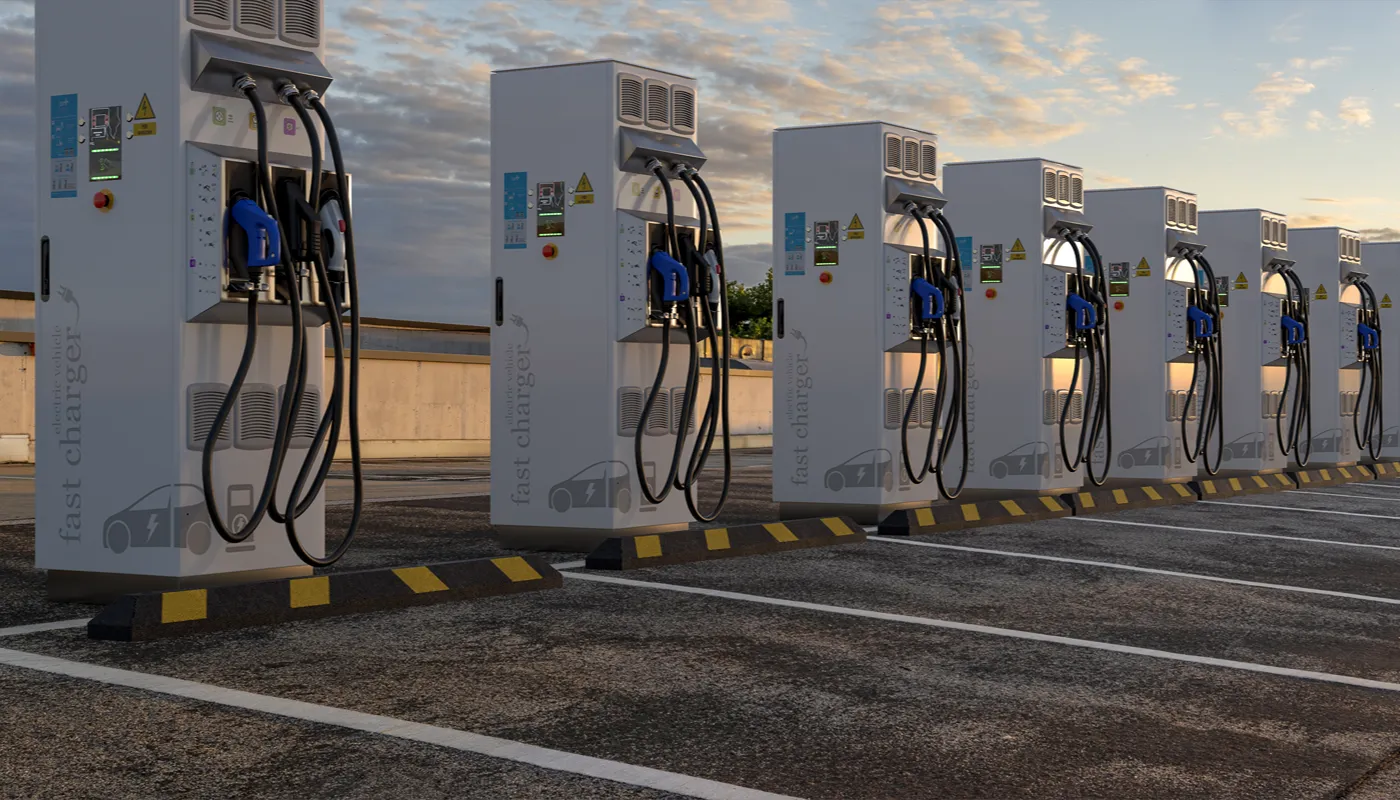
An EV charger enclosure is the exterior housing or cabinet system that protects the electrical and electronic components inside an electric vehicle charging station. Depending on the charger design, it may include the main outer housing, access panels, display surrounds, connector holsters, cable management features, bezels, doors, internal mounting points, and separate covers for serviceable components.
Outdoor chargers face rain, windblown dust, snow, ice, UV exposure, temperature swings, condensation, corrosion risks, impact, cleaning chemicals, and public handling. In commercial or fleet settings, they may also face vandalism, vehicle contact, cable abuse, and frequent service access. A durable enclosure must protect internal components, maintain the intended environmental rating, support thermal control, allow safe service, and retain its appearance over time.
Outdoor charger programs run into trouble when the enclosure is treated as cosmetic housing throughout the design process. When this happens, the material, seal path, wall sections, bosses, mounting features, vents, inserts, and finish may already be negatively impacting performance. A better approach is to define the enclosure as an engineered part from the start.
The Installation Environment Drives Material and Design Decisions
The installation environment should be defined before material selection or enclosure details are finalized. A charger mounted inside a private garage does not face the same conditions as a pedestal charger in a parking lot, a curbside unit in a city, or a fleet charger in a depot. Rain exposure, dust, road salt, coastal air, wind, public access, cable load, temperature range, and service frequency all change the enclosure requirements.
For outdoor chargers, those conditions affect more than resin choice. The enclosure design should account for direct water exposure from rain and splashing, wind-driven debris, freeze-thaw cycles, UV exposure, and heat from both the electronics and the sun. If the charger is installed near roads, deicing salts can also increase the risk of corrosion for inserts, fasteners, hinges, brackets, and other exposed metal components.
Once the environment is defined, the team can translate those conditions into enclosure requirements. That includes the rating target, material properties, wall thickness, structural features, gasket strategy, hardware, and surface finish. It also helps avoid overbuilding. A residential wall-mounted charger and a public DC fast charger do not require the same enclosure strategy.
Material selection should follow those requirements. For molded plastic enclosures, OEMs often evaluate engineered thermoplastics based on impact resistance, dimensional stability, flame performance, processability, finish quality, and cost. Common options may include polycarbonate, PC/ABS blends, ASA, nylon-based materials, and other engineered resins, depending on the application.
There is no single best resin for every EV charger enclosure. A material that performs well cosmetically may not provide the needed heat resistance. Resin with strong impact properties may need UV stabilization or a protective finish for long-term outdoor use. A rigid material may still need structural ribs, thicker sections, or metal reinforcement at load-bearing points.
The enclosure material also must work with the manufacturing process. Large, molded housings may benefit from structural foam molding because it can support larger, rigid parts with a favorable stiffness-to-weight ratio and can help reduce sink and warpage. Structural foam can also help reduce costs by either lowering clamping tonnage needs or reducing material usage as compared with fully solid molded components.
Ratings Are Design Inputs
Material selection and structural design should be determined in the context of the required enclosure rating. If the charger must meet a specific outdoor protection level, that target should be set early, as it affects seams, access points, gasket compression, venting, hardware, and test requirements. In that sense, ratings are not a separate compliance check at the end. They are part of the design input from the start.
Outdoor EV charger enclosure design often references several standards and ratings, but while federal law does not mandate a specific NEMA type, UL listing and NEC adoption make enclosure performance requirements unavoidable in practice. For most commercial products, requirements come from product certification, the National Electric Code (NEC) as adopted by state and local jurisdictions, the authority having jurisdiction, and the project specifications.
EV charging projects funded under NEVI or other applicable federal programs must comply with 23 CFR Part 680, whose requirements can impact design. These Rules address charger certification, connector type, payment access, accessibility, and other system-level requirements. While they are not enclosure ratings, they can affect enclosure design because the housing must support the required hardware, access points, serviceability, and long-term outdoor performance.
For most outdoor charger programs, enclosures should be designed to meet the applicable UL product standard, NEC Article 625 installation requirements, and an outdoor enclosure rating, such as NEMA Type 3R, Type 4, or Type 4x. NEMA enclosure types are widely used in North America to describe protection against environmental conditions such as rain, sleet, snow, windblown dust, hose-directed water, corrosion, and external ice formation.
These rating targets affect the enclosure’s physical design. They influence seams, access doors, gasket compression, fasteners, vents, drain paths, wall sections, material choice, and testing. If the rating is not known until late in development, the enclosure may need a costly redesign.
Consider Common Weak Points
Weak points in outdoor enclosures include seams, door interfaces, hinge areas, gasket channels, fastener bosses, mounting points, cable exits, connector holsters, display openings, and service access points. A well-designed EV charger enclosure should intentionally address these weak points.
Wall thickness needs to support strength without causing molding problems. Ribs should add stiffness without creating sink, read-through, or stress concentration. Design bosses and inserts to satisfy actual assembly loads. Large doors and panels should resist warpage, so the seal line stays consistent.
Mounting design is just as important. A pedestal-mounted charger has different load paths than a wall-mounted charger. The enclosure may need to resist cable pull, user force, snow load, wind, vibration, and accidental contact. If the charger includes a heavy cable and connector, treat the holster area as a structural feature rather than a simple molded pocket.
For molded plastic parts, early design for manufacturability helps prevent many of these issues. Draft angles, gate locations, material flow, wall transitions, ribs, inserts, and cosmetic surfaces all affect whether the enclosure can be molded consistently at production volume.
Sealing, Moisture, and Condensation Control
Keeping water out is only part of outdoor enclosure design. The enclosure also must manage condensation, pressure changes, service openings, and water that reaches the outer surface during storms or washing.
Gasket design should begin with the enclosure geometry. The seal path needs consistent compression, supported corners, compatible hardware, and surfaces that will not distort during assembly or field use. If the door or panel warps, the gasket may lose compression, and the environmental rating may not hold.
Designers should also reduce opportunities for standing water. Drip edges, recessed seams, labyrinth paths, sloped surfaces, and drain features can help keep water away from openings and electrical interfaces. Cable entries, display windows, buttons, card readers, and connector storage areas require special attention because they protrude from the enclosure.
Condensation is a separate issue. Outdoor enclosures experience temperature swings, and the sealed air inside the housing can expand and contract, holding moisture. Depending on the design, pressure equalization, internal airflow, vent selection, coatings, or drainage strategies may be needed.
Thermal Management Is Part of Enclosure Design
EV charging equipment produces heat, and the sun adds additional thermal load. The enclosure affects how that heat leaves the system. A housing that protects against rain and dust can still fail the product if it traps heat around power electronics, displays, communication hardware, or wiring.
Thermal design starts with the internal layout. Heat-generating components should have defined heat paths, adequate spacing, and access to cooling features when needed. The enclosure may require heat sinks, vents, fans, air-to-air heat exchangers, conductive paths, reflective finishes, internal circulation, or active cooling, depending on the charger’s power level and installation conditions.
Material and color also matter. Dark colors can increase heat absorption from the sun. Surface finish can also affect whether an EV charger enclosure absorbs heat. A double-wall or shielded design may help with thermal management in some applications, but it adds complexity and cost.
Impact, Vandalism, and Long-Term Field Use
Public and commercial chargers are handled by many users, who may be rushed, in harsh weather, or have little patience. The enclosure design must account for some abuse. Cable drops, connector impacts, shopping carts, snow removal equipment, kicks, prying, and vehicle contact can all affect the product.
Impact resistance depends on material, wall thickness, rib design, geometry, fastener strategy, and how the enclosure transfers force into the structure. A brittle corner, an unsupported display opening, a thin cable holster, or a weak access door can become the first visible failure point.
Some charger programs may also specify IK ratings for mechanical impact resistance. Whether or not an IK target is required, the design team should identify abuse points early and reinforce them. Areas around connectors, screens, payment modules, doors, locks, hinges, and mounting bases deserve focused review.
IK rating is a voluntary marking that specifies the enclosure’s ability to withstand physical impacts, accidental collisions, and vandalism. The rating and testing for compliance are defined in the international standard IEC 62262. The rating scales from IK00 (no protection) to IK10 (maximum protection).
Surface Finish, Branding, and Service Information
The outer finish of an EV charger enclosure has a functional role. Texture can reduce glare, improve grip, hide minor scratches, and help the unit hold its appearance. Painting, pad printing, digital printing, hot stamping, and labels may be used for brand identity, safety information, operating instructions, QR codes, service markings, and compliance labels.
Plan these features in conjunction with the material and production processes. A molded texture may work well for some surfaces, while a painted or decorated finish may be needed for weatherability, color control, chemical resistance, or branding. Service labels and user instructions need to remain legible despite UV exposure, cleaning, abrasion, and outdoor contamination.
Build the EV Charger Enclosure Around Real Field Conditions
A durable EV charger for outdoor use must withstand water exposure, UV exposure, temperature cycling, impact, corrosion risk, heat, public handling, and service demands. The enclosure must manage all those conditions while remaining manufacturable at scale.
For OEMs, the best results usually come from early collaboration between product engineering, electrical engineering, industrial design, compliance, sourcing, and manufacturing. Material selection, enclosure geometry, sealing, thermal control, finishing, and assembly should be developed together.
Ferriot supports OEM enclosure programs with plastics engineering, structural foam molding, and large-part molding, along with in-house secondary processes, such as painting, decorating, EMI/RFI shielding, ultrasonic welding, heat staking, and final assembly. That combination can help OEMs develop the enclosure as a complete production part with coordinated design, molding, finishing, and assembly requirements.
If you are designing an EV charger enclosure, involving Ferriot early can help reduce redesign risk and improve the path from concept to production.