Key takeaway: Structural foam molding material selection matching the part’s load requirements, service environment, wall section, foam density, surface expectations, and validation plan to the appropriate resin. The best results come when resin selection, part design, tooling, and process requirements are evaluated together before the design is finalized.
Structural foam molding materials should be selected before product design begins. The resin must meet the finished part’s performance requirements and foam predictably. Cell formation, flow, shrinkage, dimensional stability, and process consistency all affect whether the part can be molded successfully. If material selection happens too late in the process, the design may need changes to wall thickness, ribs, bosses, load paths, surface expectations, or tooling assumptions.
Understanding Structural Foam Molding
In structural foam molding, an inert gas or chemical blowing agent is added to the molten plastic before or during injection into the mold, and the part is foamed under low pressure. The blowing agent expands, creating a cellular core, often referred to as a honeycomb structure. The outer layer solidifies quickly against the mold walls, forming a dense, solid skin. The resulting structure can be up to 30 percent lighter than traditional plastic parts and offers a high stiffness-to-weight ratio for large, thick-walled parts.
The process operates at a significantly lower pressure than traditional injection molding, so less clamping force is required, allowing manufacturers to mold large parts on machines with relatively low tonnage. However, because of the low pressure, structural foam molding doesn’t achieve the same dimensional accuracy as traditional molding, which delivers tighter tolerances by filling the mold cavity with solid plastic under high pressure. With proper design and process control, structural foam can still meet many engineering requirements.
While structural foam-molded parts have inherent properties, the base resin still determines most of the part’s chemical resistance, temperature range, impact behavior, stiffness, moisture response, and long-term durability.
Choosing Structural Foam Molding Materials
Resin choice for structural foam molding requires evaluating both the base polymer’s properties and its behavior during foaming. The resin determines the part’s resistance to loads, impact, chemicals, moisture, and temperature. The molding process influences part weight, cell structure, surface finish, warpage, and dimensional consistency.
The selection of molding materials for structural foam starts with the conditions the finished part must withstand. Part size and weight are only the starting point. The material also has to handle the actual load, impact risk, service temperature, chemicals, moisture, outdoor exposure, tolerance requirements, surface expectations, and any regulatory requirements. The correct choice is usually a specific resin grade with the required fillers, reinforcements, or additives rather than a broad resin family.
Surface requirements should also be considered early. Structural foam parts can show swirl marks, streaking, or variations caused by cells reaching the mold surface during filling. Material formulation, mold temperature, gas concentration, injection speed, and surface-treatment methods can improve these surface variations, but a highly cosmetic exterior may require painting, texturing, secondary finishing, or another molding process.
Define How the Part Will Carry the Load
Load bearing can describe several different conditions. A part may support a constant static weight, withstand repeated loading, resist bending across a long span, absorb an impact, or hold threaded inserts and attached equipment. Each condition places different demands on the resin and part design.
Short-term strength data alone may be misleading when a load remains in place for months or years. Thermoplastics can deform gradually under continuous stress, a behavior known as creep. Temperature, moisture, reinforcement, wall thickness, and stress concentration can increase or reduce that deformation, so long-term creep and allowable deflection should be part of the material specification.
The direction of the load also requires attention. A large panel loaded across its width may require high flexural stiffness, while a base supporting machinery may need compressive strength and resistance to long-term deformation. Parts with hinges, clips, mounting bosses, or areas exposed to impact may need greater toughness, even when the main body requires a rigid compound.
Match Structural Foam Molding Materials To Performance Requirement
Only once the application requirements are defined can a material list be helpful. Starting with a preferred resin can lead to unnecessary cost or a material that performs well in one area but poorly in another. The selection process should begin with measurable conditions such as load, exposure time, operating temperature, allowable deflection, impact energy, chemical concentration, and dimensional tolerance.
The following table provides common starting points. It should be used to narrow the choices, rather than as a final material specification.
| Part Requirement | Common Material Options | Key Verification Criteria |
|---|---|---|
| Low Material Cost & Light Weight | PP, HDPE | Stiffness requirements, creep performance, heat exposure, and surface appearance. |
| Impact & Drop Resistance | Impact-Modified PP, PE, ABS, PC/ABS, PC | Impact performance at actual service temperature and target foam density. |
| High Stiffness & Structural Loads | Filled or Reinforced PP, PA, PBT, PET, PC, Modified PPE | Foaming compatibility, creep resistance, density reduction, fiber orientation, weld lines, cell structure, surface finish, and tool wear. |
| Dimensional Stability | ABS, PC/ABS, PBT, PET, Modified PPE | Shrinkage, warpage, thermal expansion, moisture absorption, fiber orientation, and dimensional changes at intended foam density. |
| Elevated Temperature Service | PC/ABS, PC, PA, PBT, PET, Modified PPE | Continuous-use temperature performance rather than short-term heat resistance. |
| Chemical & Moisture Resistance | PP, PE, POM, PBT, PET, Selected Modified PPE Grades | Chemical type, concentration, exposure duration, applied stress, and operating temperature. |
| Outdoor Applications | UV-Stabilized PP, PE, PC, ABS Blends, Engineered Compounds | Weathering performance, UV exposure, water resistance, thermal cycling, impact retention, and color stability. |
| Flame, ESD, or Conductive Requirements | Specialty Formulated Grades | UL rating requirements, electrical resistance range, wall thickness, and final foam density. |
| Recycled Content Goals | Qualified Post-Industrial & Recycled Formulations | Lot consistency, contamination levels, mechanical property retention, and color consistency. |
Overview of Common Resin Options
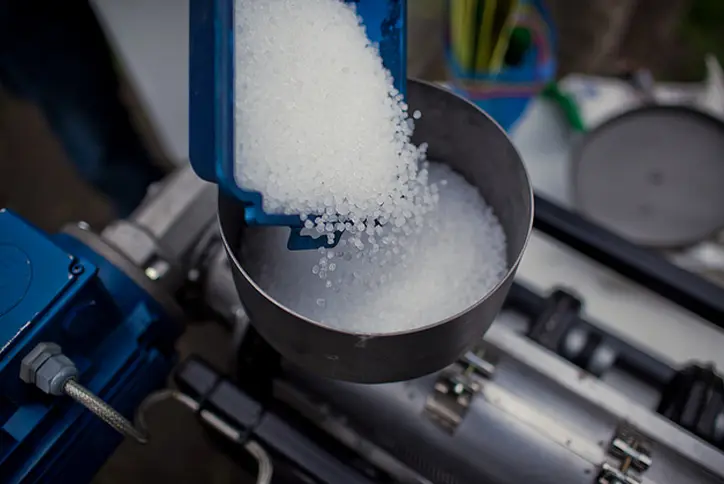
Several resin families are commonly used in structural foam molding; each has specific properties that can impact cost, weight, strength, and environmental resistance.
Commodity Resins
- Polypropylene and polyethylene are often selected for large parts where low weight, chemical resistance, and cost control are priorities. They perform well in many industrial and outdoor environments but require careful evaluation of stiffness, creep, and temperature limits.
- ABS and PC/ABS are frequently used for housings and enclosures that require dimensional stability, toughness, and a more controlled surface appearance. PC/ABS can extend impact and temperature performance beyond standard ABS when needed.
Engineering Resins
- Polycarbonate provides higher impact resistance and heat capability than many commodity resins, making it suitable for protective or higher-temperature applications. Chemical compatibility and processing control are important considerations.
- Nylon, PBT, and PET are engineering resins used when higher stiffness, strength, or dimensional stability is required, especially under load or elevated temperature. Reinforced grades can improve performance but introduce directional properties and processing considerations.
- Modified PPE is used when low moisture absorption and dimensional stability are critical, particularly in humid or wet environments. Performance varies widely by formulation.
- Acetal and TPU are specialized options. Acetal may be considered for wear or low-friction applications, while selected TPU grades may support flexible or impact-absorbing features if compatible with the foam process.
How Fillers and Additives Change the Result
Glass fibers increase stiffness, strength, creep resistance, and dimensional control, making them useful for large parts that carry continuous loads. The trade-offs can include higher density, greater tool wear, more visible surface texture, and directional properties resulting from fiber orientation. Long flow paths and weld lines require particular attention because the reinforced material may not perform uniformly in all directions.
Mineral fillers can increase stiffness and reduce shrinkage or warpage. They may be selected for large flat surfaces that must maintain their shape, but they can add weight and reduce impact strength. The type and percentage of filler should be selected to achieve the desired balance among stiffness, toughness, surface quality, and cost.
Flame-retardant, UV-stabilized, ESD, and conductive compounds require performance data to support claims. A flame-retardant grade should be tied to the required UL rating and molded thickness. Conductive compounds should be selected according to a defined surface- or volume-resistance range. UV-stabilized grades should be evaluated for the expected exposure period, climate, and color requirements.
Post-industrial and recycled resin formulations may also be appropriate when the material stream is controlled. Variation in contamination, prior heat history, additive content, viscosity, and moisture can affect both cell formation and mechanical performance. Specifications for incoming materials and production testing are required when recycled content is used in a structural part.
Design the Part and Select the Material Together
The resin cannot compensate for a poorly designed load path. Wall thickness, ribs, radii, bosses, inserts, attachment points, unsupported spans, and transitions between thick and thin sections influence how force moves through the part. Structural foam molding allows thicker walls and molded-in features, but those features must be positioned to support the load without creating stress concentrations.
Material, mold, and part design should therefore be developed together. Mold-flow analysis can help identify filling problems, weld lines, and areas where fiber orientation or foam development may affect performance. Structural analysis and physical testing can then determine whether the proposed resin and geometry meet deflection, impact, and durability requirements.
Select a Specific Grade, Then Validate It
The final specification should identify a resin grade, reinforcement level, additive package, color, blowing agent, and acceptable recycled content rather than naming only a polymer family. It should also define target part density and the mechanical, dimensional, environmental, and cosmetic tests the finished component must pass.
Large load-bearing parts should be tested under representative conditions. That may include sustained loading, elevated temperature, humidity, chemicals, impact, vibration, outdoor exposure, and repeated assembly loads. Testing a molded prototype under the expected load direction provides better evidence than comparing nominal strength values from solid test bars.
There is no universal “best” structural foam material. The right grade depends on the load case, environment, wall section, foam density, finish requirements, and how the part will be tested.
Get Structural Foam Material Support Before Tooling
Ferriot supports OEM projects with engineering, mold design, resin selection, structural foam molding, finishing, and assembly services. We typically stock more than 150 resin varieties and can obtain non-stock items quickly from our supply partners to address unique requirements. Our combined material and process knowledge allows us to compare structural foam molding materials by evaluating the needs of the entire part rather than selecting a resin based on isolated property values because resin data sheets do not tell the whole story. A grade that looks good on paper still has to mold well, foam consistently, meet the load case, and produce an acceptable surface. We can help you find the appropriate material for your structural molded application.
Talk with Ferriot early in the design process to review material options, part geometry, tooling requirements, and production risks before committing to a resin or mold design.