Key Takeaway: Plastic can outperform metal in industrial control panel enclosures when corrosion resistance, lower weight, molded-in features, part consolidation, or large-part structural foam molding reduce cost and complexity without compromising operating requirements. Metal may still make sense when requirements exceed what an engineered plastic can reliably handle.
Industrial control panel enclosures are expected to do more than protect electrical components. In modern automation systems, they also affect installation costs, equipment weight, maintenance requirements, corrosion resistance, and long-term reliability. For decades, metal has been the default choice for industrial control panel enclosures. Steel and aluminum remain important materials, particularly in extreme environments. However, advances in engineered thermoplastics and manufacturing processes have expanded the range of applications where plastic is not only a viable alternative but the better option.
Why Material Selection Matters in Industrial Automation
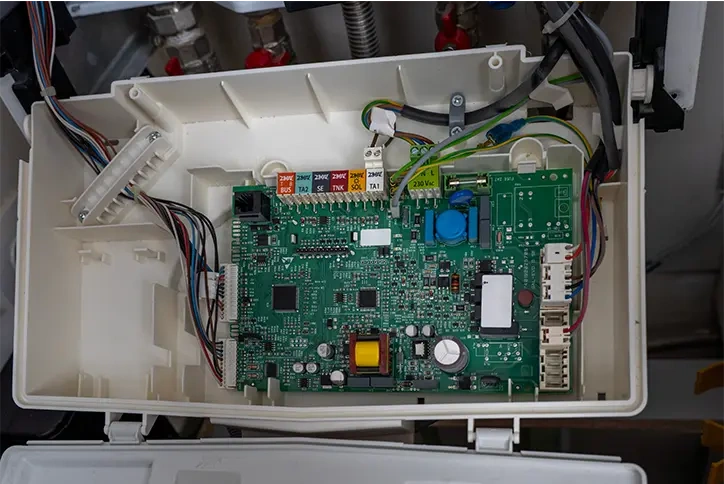
Control panel enclosures protect sensitive electronics, wiring, PLCs, sensors, HMIs, power supplies, and communication equipment from environmental hazards. Dust, moisture, chemicals, temperature fluctuations, impact, and vibration can all affect system performance and uptime. The enclosure itself can also influence manufacturing and operating costs. A heavier enclosure may require larger mounting structures. Multiple metal components often increase assembly complexity. Corrosion protection may add coatings, treatments, or maintenance requirements throughout the equipment’s service life.
Control components are often spread across the machine, production line, or facility. For example, smaller control panels, sensors, HMIs, I/O modules, drives, and communication devices may be placed closer to the equipment they control. As automation systems become more distributed in this manner and equipment designs become more compact, manufacturers are reevaluating whether traditional metal enclosures remain the best fit for every application.
Where Plastic Has an Advantage Over Metal
Beyond cost, performance characteristics are frequently the deciding factor in converting from metal to plastic for industrial control panel enclosures.
Corrosion Resistance Without Additional Treatments
Metal enclosures operating in humid environments, washdown areas, outdoor installations, or chemically aggressive settings often require coatings, painting, galvanization, or stainless steel construction to resist corrosion. Many engineered thermoplastics resist moisture and corrosion, and selected grades can withstand specific chemicals when matched to the exposure conditions. They do not rust, and they maintain their appearance and performance without secondary surface treatments. However, outdoor and chemical-exposure applications still require material selection around UV stability, chemical compatibility, temperature, and cleaning agents.
For industrial automation equipment used in food processing, water treatment, agricultural systems, or chemical handling applications, corrosion resistance may significantly simplify enclosure design and long-term maintenance.
Lower Weight Supports Easier Installation
Large automation systems may contain multiple enclosures across a machine, conveyor line, or production cell. Reducing enclosure weight can lower transportation costs and simplify installation. Properly designed plastic components can weigh less than comparable metal designs while meeting application-specific requirements for stiffness, impact resistance, mounting strength, and environmental exposure. This becomes particularly valuable for:
- Wall-mounted control systems
- Remote monitoring stations
- Portable industrial equipment
- Operator interface housings
- Field-installed automation systems
Reducing weight can also remove stress from mounting hardware and supporting structures.
Greater Design Freedom
Metal fabrication processes place limitations on geometry. Features often require secondary operations, additional hardware, welding, or assembly steps.
Injection-molded plastic enclosures can incorporate:
- Integrated mounting bosses
- Cable management features
- Snap-fit assemblies
- Complex internal geometries
- Molded-in branding and identification
- Textures and cosmetic features
These design possibilities can reduce part count and simplify assembly operations. A component that currently requires multiple fabricated metal pieces may be redesigned as a single molded plastic enclosure, reducing manufacturing complexity and improving consistency.
Structural Foam Expands What Plastic Can Do
One reason more industrial OEMs are considering plastic for larger industrial control panel enclosures is the advancement of structural foam molding. Traditional injection molding can become challenging as part size increases. Structural foam molding addresses this issue by creating a cellular core structure within the molded component. The cellular core can improve stiffness-to-weight and reduce sink in large sections, while resin selection and part design determine dimensional stability. While structural foam does not make plastic equivalent to metal in every load case, it can provide performance and design characteristics needed for many enclosure and housing applications.
Structural foam is particularly well suited for:
- Large industrial housings
- Automation equipment covers
- Electrical enclosures
- Machine control cabinets
- Operator consoles
- Equipment shrouds
Structural foam molding is successfully used to manufacture large, durable plastic components that would traditionally be produced from fabricated metal assemblies. The process enables large part production while maintaining strength and reducing overall weight. In many applications, structural foam also allows designers to incorporate reinforcing ribs and structural features that would be difficult or expensive to achieve with sheet metal fabrication.
Plastic Can Reduce Manufacturing Complexity
Material selection also affects how the enclosure moves through production. A fabricated metal enclosure may require cutting, punching, bending, welding, grinding, hardware insertion, surface preparation, finishing, painting, inspection, and final assembly. Each step adds handling time and creates another point where dimensional variation, cosmetic defects, coating issues, or schedule delays can enter the program.
This becomes more important when the enclosure is not a simple box. Industrial control panel enclosures often need knockouts, gasket surfaces, mounting features, cable routing, bosses, ribs, stand-offs, vents, labels, covers, and access points. In metal, many of these features are added through separate parts or secondary operations. In a molded plastic design, several of those features can be built into the tool and produced as part of the enclosure itself.
For higher-volume programs, this may reduce:
- Part count
- Assembly labor
- Supply chain complexity
- Secondary operations
- Production variability
The benefit is not only fewer process steps. Fewer parts can mean fewer drawings to control, fewer suppliers to coordinate, fewer purchased components to inspect, and fewer assembly errors to manage. For OEMs building automation equipment across multiple product lines, this can reduce engineering changes, simplify inventory, and make production planning more predictable. A simplified manufacturing process can improve consistency while reducing opportunities for defects and production delays.
These advantages depend on program volume and part design. Plastic conversion is usually strongest when molded features, part consolidation, assembly reduction, or performance requirements justify the tooling investment. For very low-volume builds, fabricated metal may remain more economical.
When Metal Still Makes Sense
Plastic is not the right solution for every industrial control panel enclosure. Some applications still favor metal when the operating conditions exceed the thermal, mechanical, electrical, or regulatory limits of the available plastic materials. High-temperature engineered plastics can perform well in many elevated-heat environments, but material selection must account for continuous-use temperature, short-term temperature spikes, flame resistance, dimensional stability, and long-term exposure.
Certain applications continue to favor metal due to extreme operating conditions such as:
- Temperatures beyond the rated limits of suitable engineered plastics
- Direct flame exposure or severe radiant heat
- High mechanical loading or structural load-bearing requirements
- Severe impact or abrasion risk
- Certain hazardous or code-driven environments
The choice should be based on the application’s operating environment, performance requirements, compliance considerations, and lifecycle costs. The most successful enclosure programs evaluate functional requirements first rather than defaulting to historically used materials.
Questions to Ask Before Moving from Metal to Plastic
Choosing between metal and plastic is a design and manufacturing decision first. The early questions should test whether the enclosure is a good candidate for conversion, before the team gets into resin selection, ratings, and detailed engineering requirements.
- Is corrosion resistance a recurring design, maintenance, or warranty concern?
- Would lower enclosure weight improve installation, mounting, shipping, or equipment handling?
- Are multiple fabricated metal parts increasing assembly labor or supplier coordination?
- Could molded-in features reduce part count, fasteners, inserts, brackets, or secondary operations?
- Is the enclosure large enough or complex enough to benefit from structural foam molding?
- Does the expected production volume justify tooling when compared with fabricated metal?
If the enclosure is a strong candidate for plastic, the next step is to qualify the material and application. These questions help narrow the choice of resin, additives, wall thickness, reinforcement, gasketing, and shielding options.
- What continuous-use temperature and short-term peak temperatures will the enclosure see?
- Will the enclosure be exposed to direct flame, radiant heat, UV, washdown chemicals, oils, solvents, or cleaning agents?
- What impact, vibration, mounting loads, and cable loads must the enclosure withstand?
- Does the application require grounding, bonding, EMI/RFI shielding, or conductive features?
- What enclosure rating, flame rating, agency approval, or customer specification applies?
- How will the selected material perform over the expected service life, including heat aging, chemical exposure, and dimensional stability?
The answers should not force the decision toward one material by default. They should show whether plastic can meet the operating requirements while reducing weight, corrosion risk, assembly work, or production variability. When those conditions align, a plastic enclosure can offer advantages that extend well beyond material cost. Once the application requirements are clear, the next step is to work with a plastics manufacturer to evaluate the part design, material requirements, tooling needs, and production process.
Work With Ferriot on Industrial Control Panel Enclosures
Ferriot works with OEMs that need plastic enclosures, housings, and large molded components for industrial, electronics, medical, business equipment, and commercial applications. For industrial control panel enclosures, our experience across industries and applications is useful because the enclosure is rarely just a cover. It must protect electronics, support mounting hardware, route cables, manage access, maintain dimensional stability, and perform under the conditions in which the equipment operates. Our experience provides a strong foundation for solving complex, challenging issues related to the conversion.
Before tooling begins, we help OEM teams evaluate whether an industrial control panel enclosure is a good candidate for plastic molding. That review includes the part design, resin requirements, molding process, structural features, secondary operations, and validation needs. An early review can help identify whether a plastic conversion is realistic, whether structural foam molding is appropriate for the part size and load case, and which material properties need to be verified before the program moves forward.
Our capabilities include engineering and design support, material selection guidance, mold design, custom injection molding, structural foam molding, large-part molding, gas-assist molding, finishing, decorating, EMI/RFI shielding, assembly, testing, and fulfillment. Keeping those services connected helps reduce handoffs between suppliers and gives OEM teams a clearer path from design review to production.
FAQ: Plastic Industrial Control Panel Enclosures
Can plastic replace metal for industrial control panel enclosures?
Plastic can replace metal when the enclosure requirements match the selected material and molding process. The design still needs to account for heat, impact, mounting loads, UV exposure, chemicals, shielding, enclosure ratings, and service life. When those requirements are addressed, plastic can reduce weight, corrosion risk, part count, and assembly work.
Can plastic enclosures handle high temperatures?
Some engineered plastics can perform in elevated-heat environments, but the answer depends on the resin, additives, wall thickness, exposure duration, and operating conditions. Material selection should evaluate continuous-use temperature, short-term heat spikes, flame resistance, dimensional stability, and long-term heat aging. Metal may remain the better option when the application exceeds the limits of suitable engineered plastics.
Are plastic control panel enclosures corrosion resistant?
Many engineered thermoplastics resist moisture and corrosion because they do not rust like steel. Chemical resistance still needs to be matched to the application. UV exposure, washdown chemicals, oils, solvents, cleaning agents, temperature, and exposure time can all affect material performance.
When is structural foam molding useful for enclosures?
Structural foam molding is useful when the enclosure or housing is large, needs lower weight, and benefits from molded-in ribs, bosses, mounting features, or complex geometry. The process can improve stiffness-to-weight and reduce sink in larger sections. It does not make plastic equal to metal for every load case, so the part still needs to be evaluated against mechanical, thermal, and environmental requirements.
When should OEMs evaluate a metal-to-plastic conversion?
OEMs should evaluate conversion before the enclosure design is finalized and before tooling decisions are made. Early review gives the team time to assess part geometry, material options, molded-in features, shielding needs, enclosure ratings, validation requirements, and production volume. Waiting until late in the program can limit the cost, weight, and assembly benefits that plastic molding may provide.